Astrology 101, Pt 2: Tropical vs Sidereal Zodiac

Part 1, Part 3

Welcome back to my intro to astrology series! Last time I gave a brief overview of the history of astrology and today I will be diving into how the zodiac is calculated. This series is here for people who are clueless about astrology and would like to develop a working knowledge of it. So please, do not use my series to administer astrological consultations to other people, as this will not prepare you to be able to ethically do that. This is to empower you to understand your own chart and understand what astrologers are talking about when you consult them.

Let’s dive in.

Tropical vs Sidereal Zodiac

In modern times, especially in the west, the zodiac is often taken for granted without realizing that there actually two to choose from: tropical or sidereal. In short, the tropical zodiac maps the zodiac by the Sun’s position relative to the Earth’s equator, while the sidereal zodiac maps the zodiac by the Sun’s position relative to the fixed stars that make up the 12 constellations of the zodiac. In the west, the tropical zodiac is the primary zodiac while in Vedic the sidereal zodiac is used. How did this happen? It helps to go back to our history lesson.

Chart depicting the ecliptic projected onto the zodiacal constellations.
Source: Glenn Perry

As you may recall, the 12-sign zodiac we are familiar with was created by the Babylonians around 500 BCE. They accomplished this by projecting the ecliptic, which is the path the Earth orbits around the Sun, outwards into space and observed the constellations that crossed it. If you observe the sky, there are actually 13 constellations that lie on the ecliptic and they do not all take up equal space. The 13th constellation, Ophiuchus, sits nearly directly atop of Scorpius but is discarded. The zodiacal wheel that we know of is a 360° circle that is divided into 12 equal portions of 30° each – this is a standardization that does not accurately reflect the true distribution of constellations across the ecliptic, but is convenient for the purpose of natal astrology and mathematical divisions. The image below shows the distribution of constellations along the ecliptic. You can observe that some constellations are wider, narrower, or only partially astride the ecliptic such as Scorpius. The 30° approximation of these signs allows for the Sun’s movements through each sign to measure to about the length of a month’s time.
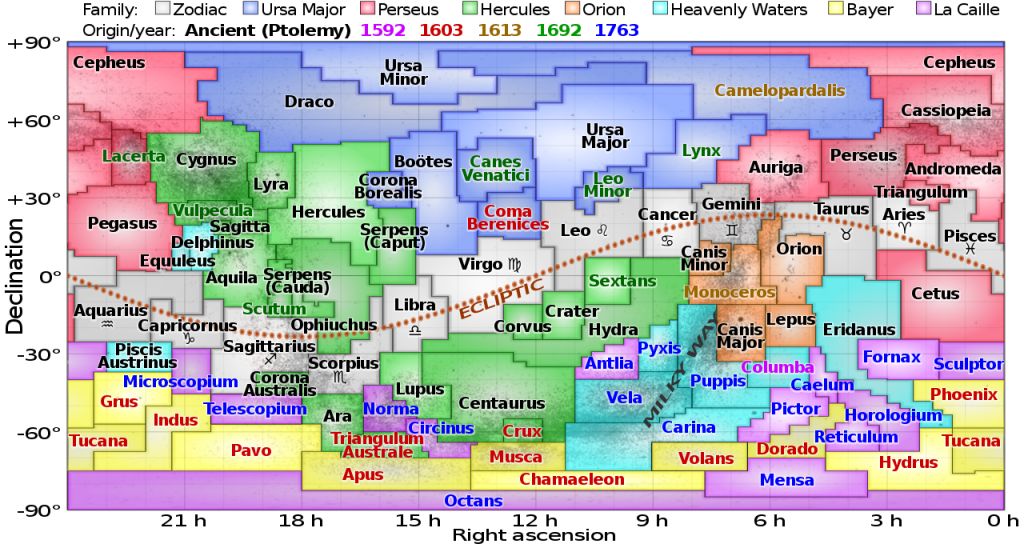
How do we get from here to two separate zodiacs? The answer is a phenomenon known as the precession of the equinoxes. You probably know that Earth’s axis is tilted, not perpendicular to the ecliptic. Due to this tilt, the Earth “wobbles” and the direction towards which its north pole points progresses along a circular path over time. The north pole currently points at the star Polaris, known as the North Star – but it did not always. This phenomenon results in the slow drifting of the dates when our annual equinoxes and solstices occur, which means that the Sun’s position in the sky is not always in the same place when we experience a given equinox or solstice as time moves forward. Thousands of years ago, the astronomical change of seasons occurred at later dates than they do now, and they are steadily occurring earlier – but not at a pace that you will be able to perceive in your lifetime.

When the Babylonians created the zodiac, the Sun’s position in the sky during the equinoxes and solstices sat in the center of the cardinal signs: Aries, Cancer, Libra, and Capricorn. During approximately 134 BCE it was the Greek astronomer Hipparchus who observed that the Sun’s position in the zodiac during these seasonal events had drifted backwards through the signs. For example, during the time of the Babylonians, the Sun occupied around 15° Aries during the Spring equinox, but had drifted to about 5° Aries during Hipparchus’ discovery. Hipparchus is credited with having discovered the precession of the equinoxes in the west, though he was not necessarily the first in the world to have done so. Later on, Ptolemy observed some time during the 2nd century CE that the Sun’s position during the Spring equinox was exactly aligned with the start of Aries. He then asserted that the zodiac must be derived from tropical coordinates – using the Sun’s position relative to the Earth – and thus the tropical zodiac was born and put to use in the west.

Source: Yvonne Harrison

What are tropical coordinates? We talked about the ecliptic, which is the path along which the Earth orbits the Sun. There is another circular plane that crosses the ecliptic known as the celestial equator, which is the Earth’s equator projected outwards. The celestial equator and the ecliptic cross at two points, and when the Sun’s position in the sky aligns with these points the equinoxes occur. When the Sun occupies its most northerly or southerly position relative to the celestial equator, the solstices occur. This is how we experience the change of astronomical seasons here on Earth. This was very relevant to agriculture during ancient times and that is why the equinoxes and solstices are paid so much attention by different cultural and spiritual practices, so it makes sense that the Babylonians would have divided the zodiacal wheel in such a way that these events occurred when the Sun was in the center of the cardinal signs. However, even though some evidence exists that suggests the Babylonians may have been aware of the precession of the equinoxes, it’s unclear how this factored into their calculation of the zodiac.

Where does that leave the sidereal zodiac? During the time of the Babylonians, and throughout the ancient world, while the equinoxes and solstices were very important, astronomical calculations were conducted relative to their sidereal positions. Of course, the zodiac started with the Babylonians and there were no two zodiacs until Hipparchus and Ptolemy emerged. The zodiac was being calculated through the sidereal method – that is how Hipparchus was able to observe that the positions of the Sun during equinoxes and solstices was shifting over time, by comparing his present calculations to the calculations of his predecessors. The sidereal method involves observing what are known as the fixed stars among the 12 constellations – 28 of these stars feature in the Indian lunar mansions from our history overview. Instead of observing the Sun’s position along the ecliptic relative to the Earth’s equator, the sidereal zodiac observes the Sun’s position relative to these fixed stars. This means that it is generally the same date year after year when the Sun’s position intersects with a given fixed star. The fixed stars have been tracked and used by the Indian tradition for thousands of years, even preceding the Babylonian zodiac, so it makes sense that we see the sidereal zodiac still in use prominently in Vedic astrology.

While tropical astrology accounts for (or doesn’t, depending on your perspective) the precession of the equinoxes by charting the zodiac according to the Sun’s movements relative to the Earth, sidereal astrologers has to make different calculations to account for precession with the sidereal zodiac. This is accomplished through what is known as an ayanamsa. An ayanamsa is the calculation of the precise degrees of separation between the start of the sidereal zodiac and the position of the Sun during the Spring equinox. There are different ayanamsas, leaving room for debate as to which one is best to use. However, the differences between them are generally incredibly marginal and relevant only to seriously meticulous astrologers.

Which Zodiac is Correct?

The debate on which zodiac is correct is neverending and frankly, insoluble. The answer largely comes down to preference and what arguments compel you the most. Tropical astrologers generally feel that the seasons are essential to the descriptions and significations associated with the zodiac signs, while sidereal astrologers feel that it is the power inherent in the stars and the mythic traditions they carry that are essential to the interpretations we’ve come to associate with the zodiac signs. While the debate will no doubt continue to carry on for eternity, you get to choose which zodiac you prefer.

Due to the precession of the equinoxes, the tropical zodiac has drifted around 24° behind the sidereal zodiac, which is why you sometimes see headlines going on about how your zodiac sign has changed. When the Sun is in tropical Aries up to about 24°, it is actually in sidereal Pisces – and will appear that way if you observe the sky. This means that interpretations could vary significantly whether you are seeing a tropical or a sidereal astrologer. It’s something to be aware of.

It should also be noted that there are Western astrologers who use the sidereal zodiac and there are Vedic astrologers who use the tropical zodiac. It really is about preference and what makes the most sense to you. I ended up converting to the sidereal zodiac because it didn’t make sense to me for the zodiac to not align to the stars in the sky. I like to be able to use my astronomical sky map to observe the position of the planets and know that the constellations I observe them in are in fact the zodiacal signs they are occupying at that moment. One of the downsides of the sidereal zodiac however is the lack of consensus around which ayanamsa should be used. Another criticism of the sidereal zodiac is that it does emphasize the seasonal rhythms we experience here on Earth. It cannot be denied how much emphasis was placed on the equinoxes and solstices in ancient times – they are universally celebrated around the world and played a huge role in the traditions that were adopted that eased people into living in accordance with the natural rhythm of the seasons. So, I understand where tropical astrologers are coming from. One major criticism of the tropical zodiac however is that much of its interpretations are relative to the way seasons are experienced in Greece – and the rest of the world is not like that. In fact, the seasons are opposite between the Southern and Northern hemispheres and must be accounted for depending on which hemisphere you are located in. This is not necessary if you use the sidereal zodiac.

So, again, it really comes down to whether you think stars are more important or seasons are more important. Compelling arguments can be made for either case. My goal here isn’t to tell you which zodiac is better or more correct – it’s to provide information so you can develop an informed opinion yourself. I meet people all the time that have no idea that there are two zodiacs, or that the tropical zodiac which is taken for granted is not anchored to the constellations in the sky. I hope that this overview has been helpful in that regard. Thank you for reading. I’ve included my sources below.

I am currently studying to become a professional astrologer and if you are interested in receiving a brief consultation please check out my rates and services page. I am grateful for opportunities to practice my skills and increase my experience.

Sources:

Harrison, Y. (2021a, December 20). Tropical Vs. Sidereal Astrology. Tilt Astrology. https://www.tiltastrology.com/post/the-tropical-vs-sidereal-year

Harrison, Y. (2021b, December 30). The Trouble with Ptolemy. Tilt Astrology. https://www.tiltastrology.com/post/the-trouble-with-ptolemy

Koch, D. (2020, January 7). Ayanamshas in Sidereal Astrology. Astrodienst. https://www.astro.com/astrology/in_ayanamsha_e.htm

Perry, G. (2021, March 1). The Two-Zodiac Problem: Toward an Empathic Understandng. Glenn Perry. https://aaperry.com/two-zodiac-problem-toward-empathic-understandng/

Astrology 101, Pt 1: A Brief History

This is the beginning of the series! Part 2

Greetings. You may not know this about me, but I am a student of Vedic astrology or Jyotish. I started out in the Western tradition when I was a teenager due to my interest in Greek mythology. It was during my college years that I discovered more traditional western methods that rely on the sidereal zodiac, and from there it was not long before I discovered the Vedic astrological tradition. I have been a hobby astrologer for over ten years and in the last year have started taking up formal courses in Vedic astrology so that I can practice astrology professionally.

I thought it would be a good idea to start sharing my knowledge of astrology, if only because I noticed that I really love to ramble on and on about it. In particular I find there is a great need for accessible information about the very fundamentals of astrology – not just chart interpretation, but its history, the rationale behind techniques, and the application of those techniques. For my first post, I will be giving a brief overview of the history of astrology. Subsequent posts will focus on more specific techniques and basics in depth.

My goal for this series is to give people the tools they need to approach astrology with confidence and an appropriate amount of discernment. This series will not turn you into a professional astrologer, but it will help you gain a working knowledge of astrology. A good analogy is automobiles – some people are clueless about cars, and talking about them is like speaking in a foreign language. Unfortunately these people are the ones who are most vulnerable to being taken advantage of by unethical shops and mechanics who will use scare tactics to get someone to pay for extra services or products they don’t really need. Then, you have people who have a working knowledge of cars – maybe they have performed their own oil change before and understand the basic components of an engine and how they are meant to behave. They understand enough to be able to keep up on maintenance and have a general idea of what might be wrong with their car when problems come up, but they cannot assess, diagnose, and repair more complicated issues. After that you have your backyard and full-fledged mechanics, who are experienced and deeply knowledgeable about cars – so much so that they are ethically able to charge money to service other person’s vehicles. So please, do not use my series to administer astrological consultations to other people, as this will not prepare you to be able to ethically do that. This is to empower you to understand your own chart and understand what astrologers are talking about when you consult them.

With that disclaimer out of the way, I am excited to get started.

History of Astrology

Humans have been tracking the movements of the stars for millennia. It is natural to be attracted to the sky and marvel at its awe. Many astronomical phenomenon such as eclipses, comets, meteorites, and constellations played a huge role in the spiritual culture of all early civilizations around the world. You may already be aware that there exist all over Europe many stone monuments that are oriented to the position of the sun during winter solstice, including the famous Stonehenge, which generally was a popular time of year for feasting rituals. Solstices, in fact, are universally celebrated around the world. We also find that the cardinal directions (North, South, West, East) are universally recognized around the world and play a large role in the alignment of the Egyptian Great Pyramid. From Iron Age meteorite worship to the Star of Bethlehem to ancient eclipse omens, humans have placed great meaning on the sky and its various celestial objects and navigation.

In modern times, astrology and astronomy are treated as separate – which isn’t necessarily wrong. During ancient times however, the two studies were often side-by-side and interchanged with each other. Before the dawn of digital astrological software and mobile apps, astrologers had to know how to look up at the sky and map the coordinates of the planets manually to paper. Astrologers had to be astronomers to do their work, though not all astronomers of the past were necessarily astrologers. While astronomy encompasses the study of celestial objects and phenomena, Astrology is specifically the practice of looking at relationships between celestial objects and events down on earth. Nearly every culture around the world practiced some kind of astrology, and therefore there are many astrological traditions around the world. This did not always look like natal astrology, which is the form we are most familiar with today and focuses on casting natal charts of individuals at the time of their birth to assess their lives. Often primitive astrology focused on predicting events in the interest of advising and protecting leaders or rulers of a given civilization, regulation of agriculture, or for charting out dates for festivals and worship of specific deities. Predicting omens by following eclipse patterns, meteors, the brightness and color of planets, and other celestial events was common. Around the world there are rich mythical traditions involving the stars and constellations identified by early civilizations and these contribute significantly to the astrological practices that have evolved over time. Therefore it is important to be aware of the cultural context out of which astrological traditions have grown.

Chart depicting the ecliptic projected onto the zodiacal constellations.
Source: Glenn Perry

The early foundations of natal astrology, which is our primary focus, started to emerge around 500 BCE in ancient Mesopotamia. The Babylonians divided the ecliptic into the 12 zodiacal signs we are all familiar with. This solar zodiac was used to keep track of the movements of the planets for the purpose of predicting omens, especially in regards to agriculture. Natal horoscopes would emerge later around 410 BCE and became commonplace by 200 BCE. The Greeks soon picked up Babylonian astrology and introduced their own ideas into it, eventually becoming what we know as the tradition of Hellenistic astrology. Much of modern astrology practiced in the west originates from the Hellenistic tradition, and especially Ptolemy’s Tetrabiblos, his landmark treatise on astrology which was produced around 2nd century CE.

Around the same time as the Babylonians, Chinese natal astrology also began to develop. The two systems are entirely independent of each other, but share many parallels, including the fear of eclipses and 12 zodiac signs. Unlike the Babylonian zodiac, the Chinese zodiac is not associated with the constellations that span the ecliptic plane. Instead, the Chinese zodiac is based on a 12-year cycle where each year is assigned a zodiacal animal. Chinese astrology also included the use of a lunar zodiac, or lunar mansions, which followed the movements of the moon along stars of 28 constellations, estimated to have been established around 3200 BCE. Lunar mansions were also used in Arabia and ancient India, where the tradition of Vedic astrology, known as Jyotish, arose and is still actively practiced today. While these systems of lunar mansions had some traits in common, they were also distinct from each other. This demonstrates that there is no one single “astrology” – there are different traditions across different cultures, each being influenced by their respective culture of origin’s myths, traditions, and philosophies.

As mentioned before, India was using lunar mansions, called nakshatras, to practice astrology alongside the Chinese. Their lunar mansion system is estimated to have emerged around 1700 BCE. The Indian tradition of astrology is well-preserved and referenced in ancient Vedic texts such as the Rigveda. One of the earliest known texts concerning Indian astrology is the Vedanga Jyotisha, estimated between 1370 and 1150 BCE. At some point around 1st century CE, the Greeks introduced Hellenistic astrology to India and some of its elements were adopted into the Vedic tradition, such as the 12-sign solar zodiac. This exchange was evidenced by the existence of the ancient text, Yavanajataka (“nativity according to the Greeks”), a Sanskrit translation of Greek astrology. The Vedic astrology tradition went on to evolve into a few different schools, one of the most widely practiced being the school of Parashara. Its tenets are outlined in the text Brihat Parashara Hora Shastra, which is a compilation of teachings thought to have been written around 600 CE.

Vedic astrology is a living tradition that is still practiced and taught in universities to this day. The Hellenistic or Western tradition fell out of favor amidst the rise of Christianity and the 16th and 17th century astronomical discoveries of heliocentrism by Copernicus and Kepler’s discovery that the orbit of planets are elliptical rather than circular, which contradicted Ptolemy’s geocentric model of the solar system. Western astrology experienced a revival in the late 19th century when psychologist Carl Jung made reference to it in his work, and with the 1920’s seeing the emergence of newspaper horoscopes. Not long after, New Age spirituality heavily popularized sun sign astrology in the late 1960’s and 1970’s, with Linda Goodman’s 1968 release of Linda Goodman’s Sun Signs being the first astrology book to make it on the New York Times Best Seller List. This modern western astrology is more focused on the personality of the individual being read for, a reflection of the individualistic values of modern western society. Other traditions such as Chinese are still practiced today in some folk traditions, though not with the same widespread recognition as Western and Vedic astrology. As a whole, astrology is still widely regarded as pseudoscience outside of spiritual or folk communities, though many people enjoy indulging in sun sign horoscopes and merchandise.

Still, those who practice astrology in the modern age do take it seriously and there exists rigorous programs of study for those who are serious about becoming a professional astrologer or astrological scholar. As previously mentioned, Indian universities offer courses in astrology and students can go on to earn their PhD in astrological sciences. There exist scholarly journals devoted to publishing astrological research. Additionally, there exist organizations that provide professional certifications such as the American Federation of Astrologers and the Council of Vedic Astrology. Other astrology organizations include The Organization for Professional Astrology, The Astrological Association, and International Society for Astrological Research. Worldwide every year there are astrology conferences where professional astrologers and scholars gather to exchange ideas and continue their education. By no means is astrology dead, nor is it anything to sneeze at either.

That concludes my brief overview of the history of astrology. I hope this was useful and helped broaden your understanding of modern astrology and its origins. Again, I am currently studying to become a professional astrologer and if you are interested in receiving a brief consultation please check out my rates and services page. I am grateful for opportunities to practice my skills. I currently do not offer predictions, but am happy to briefly look at your natal chart and convey what comes to me. I’ve included my sources below. I especially recommend the Great Courses’ The Remarkable Science of Ancient Astronomy available on audible. Thank you for reading!

Sources:

Perry, G. (2021, March 1). The Two-Zodiac Problem: Toward an Empathic Understandng. Glenn Perry. https://aaperry.com/two-zodiac-problem-toward-empathic-understandng/

PsyMinds, P. M. (2021, February 21). A Brief History of Vedic Astrology. PsyMinds. https://psy-minds.com/vedic-astrology-jyotish/

Schaefer, B. E. (2017). The Remarkable Science of Ancient Astronomy [E-book]. https://www.audible.com/pd/The-Remarkable-Science-of-Ancient-Astronomy-Audiobook/1629976121

Wikipedia contributors. (2022a, June 4). Vedanga Jyotisha. Wikipedia. https://en.wikipedia.org/wiki/Vedanga_Jyotisha

Wikipedia contributors. (2022b, June 20). Brihat Parashara Hora Shastra. Wikipedia. https://en.wikipedia.org/wiki/Brihat_Parashara_Hora_Shastra

Wikipedia contributors. (2022c, July 28). Yavanajataka. Wikipedia. https://en.wikipedia.org/wiki/Yavanajataka