Astrology 101, Pt 5: Chart Structure

Part 4

Welcome back to my intro to astrology series! Last time I went over the planets and today I will be diving into natal chart structure and a little bit about houses. This series is here for people who are clueless about astrology and would like to develop a working knowledge of it. So please, do not use my series to administer astrological consultations to other people, as this will not prepare you to be able to ethically do that. This is to empower you to understand your own chart and understand what astrologers are talking about when you consult them.

We are now ready to start exploring charts. The components of a natal chart depict what positions the planets occupy in the sky relative to the zodiac and then divide the zodiac into houses. Houses are where deep astrological analysis is able to take place. We know there are 12 zodiac signs, and these also make up 12 houses in a natal chart. This is the part of natal astrology where people’s heads tend to start spinning. There are all kinds of different chart styles and housing systems and it can be difficult to understand what is being represented in a chart. To really understand what we are seeing in a natal chart, we need to start with the sky.

Above is a screenshot I’ve taken in the free stargazing application, Stellarium. This application allows us to observe a simulation of the sky outside. I’ve chosen a random location near the equator so that the ecliptic cuts as straight across the sky as possible. Then, I zoomed out so you could see the entirety of the sky. In red you can see the compass directions. When you look to the eastern horizon, you are looking towards a point in the sky that is referred to as the ascendant or lagna (Sanskrit) in astrology. The ascendant specifically is the point where the eastern horizon meets the ecliptic, and thus the zodiac. This point shifts around depending on how close or far away you are from the Earth’s equator. The zodiac sign where the ascendant falls is commonly called the rising sign because it literally rises above the horizon and across the sky throughout the day, just like our Sun. Opposite this point is called the descendant, at the western horizon where the sun sets. Between them lies the midheaven, which sits opposite the imum coeli – through the ground to the opposite side of the earth where you are located. In terms of natal astrology, these four points represent the cardinal houses (1st, 4th, 7th, and 10th houses).

Before we get deeper into houses we need to briefly go over chart design and components. A chart shows us the position of the zodiac signs and which of the 12 houses they occupy. There are many styles for how to draw a natal chart. The Western tradition typically uses a circle, while the Vedic tradition uses a couple different shapes: the “diamond chart” (North Indian Style), and the “square chart” (South Indian Style). All three are pictured below:

While they look vastly different from each other, these chart styles are all able to accomplish the same thing: giving us a pictorial representation of the positions of the planets, zodiac, and houses across the sky. Your chart style preference is largely going to come down to whether you prefer the houses to be stationary (Western Chart Style and North Indian Style), or the zodiac to be stationary (South Indian Style). I prefer the former, so I tend to use the Western and North Indian styles in my practice. The movement of the zodiac in these two styles is consistent with the way it looks in the sky, which is part of why I like it.

Circling back to before, now that we know about the cardinal points and chart styles we can start understanding how a chart relates to the sky. In any chart style, the ascendant or the 1st house always represents the eastern horizon, while the descendant or 7th house always represents the western horizon. The midheaven or 10th house always represents the highest point up in the sky, while the imum coeli or 4th house always represents the lowest point beneath the ground from where you are located. Therefore, houses 7 through 12 are “above ground” and visible to us in the sky, while houses 1 through 6 are “below ground” or not visible to us.

Now we are ready to dip into houses. In natal astrology, the zodiac is divided into 12 houses in addition to the 12 signs. There are many methods of calculating houses, but since this is meant to be an introductory level series I am going to focus on whole signs houses. In the whole signs scheme, each astrological house is the full 30 degrees of a sign, starting with the ascendant. The houses begin where the signs begin, which means the ascendant can fall anywhere within the 1st house.

Let’s cast a chart for the positions we captured in Stellarium. Note that since we are using the positions of the constellations themselves, this is going to be a sidereal chart. Using the image from before, we can see that the ascendant is located at the very end of Taurus in the sky, which makes Taurus the 1st house. This defacto makes the 7th house Scorpio. The midpoint between the two falls in Aquarius, the 10th house, which makes Leo the 4th house – which we cannot see in the sky because it is “beneath” us. Here is what such a chart would look like in the Western style:

You’ll find the ascendant, called the AC, is located at the very end of Taurus. The line that represents the ascendant-descendant axis is the plane from which we can observe the sky. Planets above this line are visible to us in the sky (depending on whether it it night or day, etc.), and if we were to look up at the night sky represented in this chart we would see Jupiter and Saturn among the stars. The other planets in the chart would not be visible because they are on the other side of the earth. If you remember, the lunar nodes are fictitious points in the sky, so we cannot see them regardless of where we are. You’ll also see a point in this chart called the MC; this is the true mathematically calculated midheaven in the sky, which doesn’t always fall in the 10th house depending on where on the globe you are located.

Beside the planetary glyphs you will see numbers. These numbers tell us what degree of a zodiac sign the planet occupies. Zodiac signs are measured in degrees and minutes. Degrees represent the angular degrees of a circle – the zodiacal wheel being a 360 degree circle divided into 12 sections. Minutes are a single degree divided into 60 parts. Each zodiac sign is 30 degrees long, starting with 0 degrees and 0 minutes going up to 29 degrees and 59 minutes. In this chart you will see that the Moon is located at 9 degrees and 59 minutes of Leo – this Moon is in the very end of the 10th degree of Leo. Meanwhile, Mercury is located at 21 degrees and 01 minutes of Virgo, meaning Mercury has just entered the 22nd degree of Virgo. Degrees can carry some meaning, but it is not necessary to know in great detail at this stage. A general rule of thumb for degrees is that the higher a degree is, the more “mature” that planet is considered to be. A planet such as Mars at 0 degrees and 48 minutes Gemini is considered a very “young” planet, just getting started in his journey through Gemini.

By now, you should be able to look at a chart and be able to tell what was going on in the sky at the moment for which the chart was cast. Now we can look deeper at houses and what they represent in a chart, in the next article. See you next time.

I am currently studying to become a professional astrologer and if you are interested in receiving a brief consultation please check out my rates and services page. I am grateful for opportunities to practice my skills and increase my experience.

Astrology 101, Pt 4: Planets and Dignities

Part 3, Part 5

Welcome back to my intro to astrology series! Last time I went over the zodiac signs and their attributes. Today I will be diving into the planets and their various attributes. This series is here for people who are clueless about astrology and would like to develop a working knowledge of it. So please, do not use my series to administer astrological consultations to other people, as this will not prepare you to be able to ethically do that. This is to empower you to understand your own chart and understand what astrologers are talking about when you consult them.

The Planets

In sanskrit the planets are referred to as grahas, which means “to grasp,” in the sense that these celestial objects are regarded as representations of universal truths that grab hold of us. As human beings, we are grabbed by the influence of the planets – and this is reflected in the rich tradition of stargazing and mythmaking that has been present throughout the history of humanity as we covered in the history of astrology. Humans have always been gripped by the heavens.

In astrology when we talk about planets, we include the Sun, Moon, and the two lunar nodes even though they are not technically planets. The Sun and the Moon are known as luminaries because they give off light. The lunar nodes are mathematical points in the sky where the paths of the Sun and the Moon meet – meaning eclipses happen when the Sun and Moon come in conjunction with these points. They are not true planets, but for the purpose of astrology it’s convenient to refer to them all as planets.

In traditional astrology we use the 9 planet scheme (the 7 planets and the two lunar nodes) primarily for natal readings. The 7 planets are what’s visible in the sky to the naked eye: the Sun, the Moon, Mercury, Venus, Mars, Jupiter, and Saturn. We see the Sun during the daytime (and sometimes the Moon!), and during the nighttime we can observe the Moon and the other planets in the sky. They appear as bright shining stars – but unlike the stars, which remain stationed relative to each other, the planets move across constellations. Ancient astrologers used to study the night sky to track the movements of the planets, using the data they gathered to calculate their trajectories and predict their movements.

The outer planets Neptune, Uranus, and Pluto can be used but they are often interpreted more as generational planets because they are so slow-moving. It takes between 7 and 20 years for these planets to travel across a single zodiac sign – so their placement in the natal chart is not particularly distinguishing to the individual as they will share the placement with everyone else who was born in the last two or so generations as them. Exceptions are made when an outer planet is closely associated with one of the other 9 planets, but for now it is not necessary to go into detail about them. Below is a table of the 9 planets and their attributes.

Planet
Name
Glyph
Description
SunThe Sun is representative of our personal power and self-expression. Some archetypal associations with the Sun include patriarchs such as father and king. The Sun is a hot planet and burns quite bright – getting too close can burn others, which is why the Sun is so associated with the Self. Leo, which is ruled by the Sun, is commonly associated with children. If you think of a baby, they are totally unashamed to be themselves and this is the essence of the Sun. Babies and toddlers can also be incredibly self-centered, though. Emphasis on the Self naturally leaves less room for others, but shining our light can also act as a beacon of inspiration to others.
MoonThe Moon is our psyche – which includes our sensory perceptions and emotions. This planet represents the mother and our relationship to family in the natal chart. The Moon is highly sentimental because of the association with mother – when we are born, we are one with our mothers and if our mother is a good mother, she nurtures and protects us. When we feel safe and secure, we can delight in our sensory experiences and emotions without fear of danger. We are free to be vulnerable, therefore the moon represents our vulnerable nature as well.
MercuryMercury is the discriminating intellect – the part of our mind that learns and measures the value of things. Mercury is associated with merchants, commerce, communication, education, and also an element of trickery and fickleness. Mercury is very quick, second in speed only to the Moon, representing the speed at which one’s analytical mind operates. Mercury’s fickleness means that interests or ideas may be fleeting, but also it can mean flexibility and adaptability to changing environments – a great trait for commercial development and investing.
VenusVenus represents our relationships and how we express affection and appreciation to others. Venus is associated with aesthetic pleasures, romance, and love especially. Reciprocity is a big aspect of Venus – the act of receiving and giving in equal measures in one-to-one relationships. This idea of reciprocity is central to the creative process and divine inspiration – therefore, Venus is also heavily associated with artists of all kinds.
MarsMars is the warrior planet – driven, passionate, assertive, and courageous, he goes for what he wants and is highly focused on goals. Mars is often associated with athleticism, physical strength, competition, and conquest. As such, Mars is also associated with military and warfare. Mars is incredibly tactical and executes action with great precision.
JupiterJupiter represents higher consciousness and spiritual knowledge. The Sage is Jupiter’s archetype. Where Mercury is concerned with counting, measuring, and naming, Jupiter is concerned with philosophy, religion, and deep spiritual contemplation. Jupiter seeks to explore ideas and abstract thought. Through spiritual seeking, one finds transcendence and becomes uplifted, therefore Jupiter is associated with beneficence, expansiveness, and idealism. Jupiter is also associated with wealth and abundance.
SaturnSaturn is the planet of karmic debt and structure. Where Jupiter is expansive and uplifting, Saturn restricts and brings things back down to earth. Saturn represents longevity, obstacles, discipline, responsibility, and commitments. Saturn’s influence can feel like a dense and heavy burden in our lives, but the lessons we learn through Saturn’s hardships are what turn coal into diamonds. In truth, the world needs Saturn’s influence – we need limits in our lives, as without them we would not experience containment and would easily dissipate into nothingness. Thus, Saturn is also strongly correlated to physical matter as well.
North Node (Rahu)The North Node (referred to as Rahu in Vedic Astrology) is representative of the mythic dragon’s/serpent’s head. This is the first planet on our list that is not a true celestial object – it is merely a mathematical approximation in the sky, used to predict eclipses. When the Sun or Moon crosses the lunar nodes in the sky, it is said that they are being swallowed by the dragon’s head. The Sun and Moon become digested and transformed by their encounters with the nodes. The North Node generally shows us where we desire to grow and explore in our life, and in the case of Rahu, creates obsessions and addictions, as well as powerful material manifestations. The dragon’s head is always seeking to reunite with its body, the tail or Ketu, and so it is important to consider them as a pair.
South Node (Ketu)The South Node (referred to as Ketu in Vedic Astrology) is representative of the mythic dragon’s/serpent’s tail. The lunar nodes are always exactly opposite each other in a natal chart, and for the most part are always in retrograde motion. This comes back to the myth of the dragon who seeks to swallow the Sun and the Moon, both which can never travel in retrograde motion; they are endlessly being chased by the nodes. Where the North Node/Rahu draws us into the material realm, the South Node/Ketu creates withdrawal and detachment. The South Node/Ketu is also associated with extrasensory perception, hidden knowledge, and past lives.

Each planet is commonly associated with a deity or mythic character depending on the region where the astrological practice originates. These associations carry archetypal experiences that inform the significations of the planets. In Hindu mythology, the planets themselves are deities and are also associated with more central deities such as Shiva, Vishnu, Lakshmi, Parvati, and so on. In Greek mythology, the planets are heavily associated with the Olympian pantheon. It is worthwhile to explore the mythological associations with the planets to get a clearer understanding of the archetypal themes they represent in the natal chart.

Additionally, the traits that I have listed in the above table are influenced and sometimes intensified or impaired based on the zodiac sign that a given planet occupies. We will be going over this in the following section.

Dignities & Compatibility

The planets are good at being themselves, and the zodiac signs essentially represent the environment in which a planet is trying to express itself. Some environments are more compatible with the traits expressed by the planets than others. When a planet is placed in a compatible or supportive environment, its traits are able to bear fruitful results to the native. Likewise, when a planet is placed in an environment that is incompatible or unsupportive, we can see the planet struggle to achieve its purpose. We know what zodiac signs are harmonious for a planet by assessing that planet’s dignities and its compatibility with other planets that rule the zodiac signs.

As a general rule of thumb, planets that own fire and water signs get along with other planets that own fire and water signs. Likewise, planets that own earth and air signs get along with other planets that own earth and air signs. It makes sense, because the elemental qualities are in part related to the kinds of traits and themes that are represented by a planet. The fire and water signs are owned by the Sun, the Moon, Mars, and Jupiter, while the earth and air signs are owned by Mercury, Venus, and Saturn. The Moon is a bit of an exception to this rule, and is friendly towards all other planets. Again, this is a rule of thumb, so there will be nuance that can be discerned by more experienced astrologers.

Dignities, on the other hand, refers to a given planet’s preferred signs to be in. First and foremost, planets like to be in signs that they rule, known as domicile. We learned what signs the planets rule in the last article. Additionally, each planet also has a sign that they especially like, and when a planet is in that sign it is considered exalted. A planet in its sign of exaltation is able to embody the highest expression of its natural gifts. The opposite of exaltation is debilitation and the opposite of domicile is fall or detriment. As a rule, the sign of a planet’s debilitation or detriment is opposite its sign of exaltation or domicile, respectively. Why is that the case? It is because the sign that is opposite a given zodiac sign exhibits qualities which are in a polarizing relationship to the given sign. That is why we considered the signs as pairs in the last article – they form opposites that resist each other, but also benefit from learning from each other. When a planet finds itself occupying a sign which is opposite its domicile or exaltation, that planet is out of its element, where its natural traits are challenged or inadequate for the environment. A person who has only ever known warfare and violence, for example, is going to have under-developed empathy and compassion for others. Take this person out of a warzone and place them into a children’s nursery and they are going to find that all the skills and traits they’ve learned through war are wholly inadequate for tending to babies and children. Below is a table of the planets and their dignities:

PlanetDomicileFall/DetrimentExaltationDebilitation
SunLeoAquariusAriesLibra
MoonCancerCapricornTaurusScorpio
MercuryGemini, VirgoSagittarius, PiscesVirgoPisces
VenusTaurus, LibraScorpio, AriesPiscesVirgo
MarsAries, ScorpioLibra, TaurusCapricornCancer
JupiterSagittarius, PiscesGemini, VirgoCancerCapricorn
SaturnCapricorn, AquariusCancer, LeoLibraAries

You’ll see that the lunar nodes are missing from this list – that is because they don’t rule zodiac signs. There are some schools of thought that do assign rulership of some signs to the nodes, but I do not think that is helpful for developing a working knowledge of astrology and can create some confusion. In my opinion it is best to start out with the very bare basics before adding in more nuanced takes on astrological theory.

Know that there is no cause for panic if you have any planets in their fall or debilitation. It simply brings challenges to the areas of life those planets represent; the native generally has to work harder to practice and feel confident wielding the under-developed attributes of a fallen or debilitated planet, which has its own benefits. Even though it can take a long time to learn such lessons, often the people who have had to struggle the hardest to learn something end up mastering it in ways that others with natural acuity do not or take for granted. It takes more conscious effort to become good at something that doesn’t come naturally to us, so please do not despair. Likewise, there are some drawbacks that can be experienced with planets that are in exaltation or domicile – it all depends on context.

If you’ve been following along this far, then I would like you to challenge yourself with the following question: Why is a given planet exalted in the sign of its exaltation, and not some other sign? Choose your favorite planet and use the knowledge you’ve learned from the previous articles so far, then comment below with your answer. Next time we will be learning about the housing system and house lords. Take care.

I am currently studying to become a professional astrologer and if you are interested in receiving a brief consultation please check out my rates and services page. I am grateful for opportunities to practice my skills and increase my experience.

Astrology 101, Pt 2: Tropical vs Sidereal Zodiac

Part 1, Part 3

Welcome back to my intro to astrology series! Last time I gave a brief overview of the history of astrology and today I will be diving into how the zodiac is calculated. This series is here for people who are clueless about astrology and would like to develop a working knowledge of it. So please, do not use my series to administer astrological consultations to other people, as this will not prepare you to be able to ethically do that. This is to empower you to understand your own chart and understand what astrologers are talking about when you consult them.

Let’s dive in.

Tropical vs Sidereal Zodiac

In modern times, especially in the west, the zodiac is often taken for granted without realizing that there actually two to choose from: tropical or sidereal. In short, the tropical zodiac maps the zodiac by the Sun’s position relative to the Earth’s equator, while the sidereal zodiac maps the zodiac by the Sun’s position relative to the fixed stars that make up the 12 constellations of the zodiac. In the west, the tropical zodiac is the primary zodiac while in Vedic the sidereal zodiac is used. How did this happen? It helps to go back to our history lesson.

Chart depicting the ecliptic projected onto the zodiacal constellations.
Source: Glenn Perry

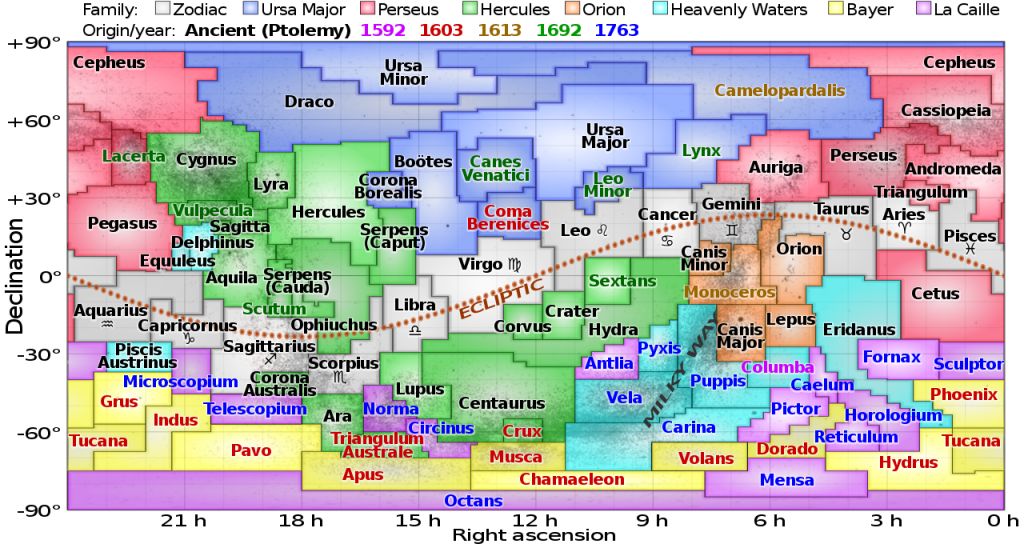
As you may recall, the 12-sign zodiac we are familiar with was created by the Babylonians around 500 BCE. They accomplished this by projecting the ecliptic, which is the path the Earth orbits around the Sun, outwards into space and observed the constellations that crossed it. If you observe the sky, there are actually 13 constellations that lie on the ecliptic and they do not all take up equal space. The 13th constellation, Ophiuchus, sits nearly directly atop of Scorpius but is discarded. The zodiacal wheel that we know of is a 360° circle that is divided into 12 equal portions of 30° each – this is a standardization that does not accurately reflect the true distribution of constellations across the ecliptic, but is convenient for the purpose of natal astrology and mathematical divisions. The image below shows the distribution of constellations along the ecliptic. You can observe that some constellations are wider, narrower, or only partially astride the ecliptic such as Scorpius. The 30° approximation of these signs allows for the Sun’s movements through each sign to measure to about the length of a month’s time.

How do we get from here to two separate zodiacs? The answer is a phenomenon known as the precession of the equinoxes. You probably know that Earth’s axis is tilted, not perpendicular to the ecliptic. Due to this tilt, the Earth “wobbles” and the direction towards which its north pole points progresses along a circular path over time. The north pole currently points at the star Polaris, known as the North Star – but it did not always. This phenomenon results in the slow drifting of the dates when our annual equinoxes and solstices occur, which means that the Sun’s position in the sky is not always in the same place when we experience a given equinox or solstice as time moves forward. Thousands of years ago, the astronomical change of seasons occurred at later dates than they do now, and they are steadily occurring earlier – but not at a pace that you will be able to perceive in your lifetime.

When the Babylonians created the zodiac, the Sun’s position in the sky during the equinoxes and solstices sat in the center of the cardinal signs: Aries, Cancer, Libra, and Capricorn. During approximately 134 BCE it was the Greek astronomer Hipparchus who observed that the Sun’s position in the zodiac during these seasonal events had drifted backwards through the signs. For example, during the time of the Babylonians, the Sun occupied around 15° Aries during the Spring equinox, but had drifted to about 5° Aries during Hipparchus’ discovery. Hipparchus is credited with having discovered the precession of the equinoxes in the west, though he was not necessarily the first in the world to have done so. Later on, Ptolemy observed some time during the 2nd century CE that the Sun’s position during the Spring equinox was exactly aligned with the start of Aries. He then asserted that the zodiac must be derived from tropical coordinates – using the Sun’s position relative to the Earth – and thus the tropical zodiac was born and put to use in the west.

Source: Yvonne Harrison

What are tropical coordinates? We talked about the ecliptic, which is the path along which the Earth orbits the Sun. There is another circular plane that crosses the ecliptic known as the celestial equator, which is the Earth’s equator projected outwards. The celestial equator and the ecliptic cross at two points, and when the Sun’s position in the sky aligns with these points the equinoxes occur. When the Sun occupies its most northerly or southerly position relative to the celestial equator, the solstices occur. This is how we experience the change of astronomical seasons here on Earth. This was very relevant to agriculture during ancient times and that is why the equinoxes and solstices are paid so much attention by different cultural and spiritual practices, so it makes sense that the Babylonians would have divided the zodiacal wheel in such a way that these events occurred when the Sun was in the center of the cardinal signs. However, even though some evidence exists that suggests the Babylonians may have been aware of the precession of the equinoxes, it’s unclear how this factored into their calculation of the zodiac.

Where does that leave the sidereal zodiac? During the time of the Babylonians, and throughout the ancient world, while the equinoxes and solstices were very important, astronomical calculations were conducted relative to their sidereal positions. Of course, the zodiac started with the Babylonians and there were no two zodiacs until Hipparchus and Ptolemy emerged. The zodiac was being calculated through the sidereal method – that is how Hipparchus was able to observe that the positions of the Sun during equinoxes and solstices was shifting over time, by comparing his present calculations to the calculations of his predecessors. The sidereal method involves observing what are known as the fixed stars among the 12 constellations – 28 of these stars feature in the Indian lunar mansions from our history overview. Instead of observing the Sun’s position along the ecliptic relative to the Earth’s equator, the sidereal zodiac observes the Sun’s position relative to these fixed stars. This means that it is generally the same date year after year when the Sun’s position intersects with a given fixed star. The fixed stars have been tracked and used by the Indian tradition for thousands of years, even preceding the Babylonian zodiac, so it makes sense that we see the sidereal zodiac still in use prominently in Vedic astrology.

While tropical astrology accounts for (or doesn’t, depending on your perspective) the precession of the equinoxes by charting the zodiac according to the Sun’s movements relative to the Earth, sidereal astrologers has to make different calculations to account for precession with the sidereal zodiac. This is accomplished through what is known as an ayanamsa. An ayanamsa is the calculation of the precise degrees of separation between the start of the sidereal zodiac and the position of the Sun during the Spring equinox. There are different ayanamsas, leaving room for debate as to which one is best to use. However, the differences between them are generally incredibly marginal and relevant only to seriously meticulous astrologers.

Which Zodiac is Correct?

The debate on which zodiac is correct is neverending and frankly, insoluble. The answer largely comes down to preference and what arguments compel you the most. Tropical astrologers generally feel that the seasons are essential to the descriptions and significations associated with the zodiac signs, while sidereal astrologers feel that it is the power inherent in the stars and the mythic traditions they carry that are essential to the interpretations we’ve come to associate with the zodiac signs. While the debate will no doubt continue to carry on for eternity, you get to choose which zodiac you prefer.

Due to the precession of the equinoxes, the tropical zodiac has drifted around 24° behind the sidereal zodiac, which is why you sometimes see headlines going on about how your zodiac sign has changed. When the Sun is in tropical Aries up to about 24°, it is actually in sidereal Pisces – and will appear that way if you observe the sky. This means that interpretations could vary significantly whether you are seeing a tropical or a sidereal astrologer. It’s something to be aware of.

It should also be noted that there are Western astrologers who use the sidereal zodiac and there are Vedic astrologers who use the tropical zodiac. It really is about preference and what makes the most sense to you. I ended up converting to the sidereal zodiac because it didn’t make sense to me for the zodiac to not align to the stars in the sky. I like to be able to use my astronomical sky map to observe the position of the planets and know that the constellations I observe them in are in fact the zodiacal signs they are occupying at that moment. One of the downsides of the sidereal zodiac however is the lack of consensus around which ayanamsa should be used. Another criticism of the sidereal zodiac is that it does emphasize the seasonal rhythms we experience here on Earth. It cannot be denied how much emphasis was placed on the equinoxes and solstices in ancient times – they are universally celebrated around the world and played a huge role in the traditions that were adopted that eased people into living in accordance with the natural rhythm of the seasons. So, I understand where tropical astrologers are coming from. One major criticism of the tropical zodiac however is that much of its interpretations are relative to the way seasons are experienced in Greece – and the rest of the world is not like that. In fact, the seasons are opposite between the Southern and Northern hemispheres and must be accounted for depending on which hemisphere you are located in. This is not necessary if you use the sidereal zodiac.

So, again, it really comes down to whether you think stars are more important or seasons are more important. Compelling arguments can be made for either case. My goal here isn’t to tell you which zodiac is better or more correct – it’s to provide information so you can develop an informed opinion yourself. I meet people all the time that have no idea that there are two zodiacs, or that the tropical zodiac which is taken for granted is not anchored to the constellations in the sky. I hope that this overview has been helpful in that regard. Thank you for reading. I’ve included my sources below.

I am currently studying to become a professional astrologer and if you are interested in receiving a brief consultation please check out my rates and services page. I am grateful for opportunities to practice my skills and increase my experience.
Sources:

Harrison, Y. (2021a, December 20). Tropical Vs. Sidereal Astrology. Tilt Astrology. https://www.tiltastrology.com/post/the-tropical-vs-sidereal-year

Harrison, Y. (2021b, December 30). The Trouble with Ptolemy. Tilt Astrology. https://www.tiltastrology.com/post/the-trouble-with-ptolemy

Koch, D. (2020, January 7). Ayanamshas in Sidereal Astrology. Astrodienst. https://www.astro.com/astrology/in_ayanamsha_e.htm

Perry, G. (2021, March 1). The Two-Zodiac Problem: Toward an Empathic Understandng. Glenn Perry. https://aaperry.com/two-zodiac-problem-toward-empathic-understandng/